Wednesday, December 25, 2013

Artists in Davao for Yolanda victims @ Abreeza Mall, Davao City


** proceeds from bought masterpieces will be donated to typhoon Yolanda victims**


THE ARTWORKS!! :D

Jon Raya
Surge
Wood art panel
Scrap wood and debris
197 x 61 cm
2013


 2
Qric Batilaran
Rise in Peace #2
Oil on canvas
61 x 61 cm
2013 


 3
Bryan Cabrera
Untitled
Oil, pen and ink on canvas
81 x 60 cm
2006


 4
Qric Batilaran
Untitled
Oil on canvas
102 x 76.5 cm
2013 


5
Dominick Pilapil
Status Quo (2 of 2)
Oil on canvas
61 x 61 cm
2013 


 6
Reagan Dieparine
Masdan ang Mga Bata
Oil on board
61 x 61 cm
2013 


 7
King Duyan
Status Quo (1 of 2)
Oil on canvas
61 x 61 cm
2013 


 8
Reagan Dieparine
Untitled
Oil on canvas
50.5 x 71 cm
2012


(i regret to say that i missed capturing this painting, but now you've got a reason to visit Abreeza mall)
9
Edmundo Viacrucis
Orchids
Acrylic on canvas
61 x 61 cm
2013


 10
Glenn Remulador
Peace in the Afternoon
Acrylic on canvas
50 x 40.5 cm
2013 


 11
Edmundo Viacrucis
Golden Carpa
Acrylic on canvas
61 x 61 cm
2013


12
Edmundo Viacrucis
Misty River
Acrylic on canvas
61 x 61 cm
2012 


 13
C. Cosio
Hikers
Oil on canvas
50.5 x 61 cm
2005


 14
Bong Espinosa
Inahan sa Kalinaw
Acrylic on canvas
61 x 61 cm
2013 


15
Dennis Puzon
Minor Suspects
Acrylic on canvas
91.5 x 60.5 cm
2013 


 16
Vyankka Balasabas
Ceasefire
Oil on canvas
61 x 61 cm
2013


 17
Rosamond Aljar
Love Into the Light
Acrylic on canvas
61 x 61 cm
2013


18
Jun Cayas
Kalinaw Series (1 of 2)
Inter-media on canvas
61 x 61 cm
2013


 19
Jeff Bangot
Vanishing
Acrylic on canvas
61 x 61 cm
2013 


 20
Boylin M. Poral Jr.
Art for Peace
Acrylic on canvas
61 x 61 cm
2013


 21
Victor Dumaguing
Guitar 1
Mixed media on wood
13.5 x 19 cm
2013 


 22
Victor Dumaguing
Guitar 2
Mixed media on wood
13.5 x 19 cm
2013


 23
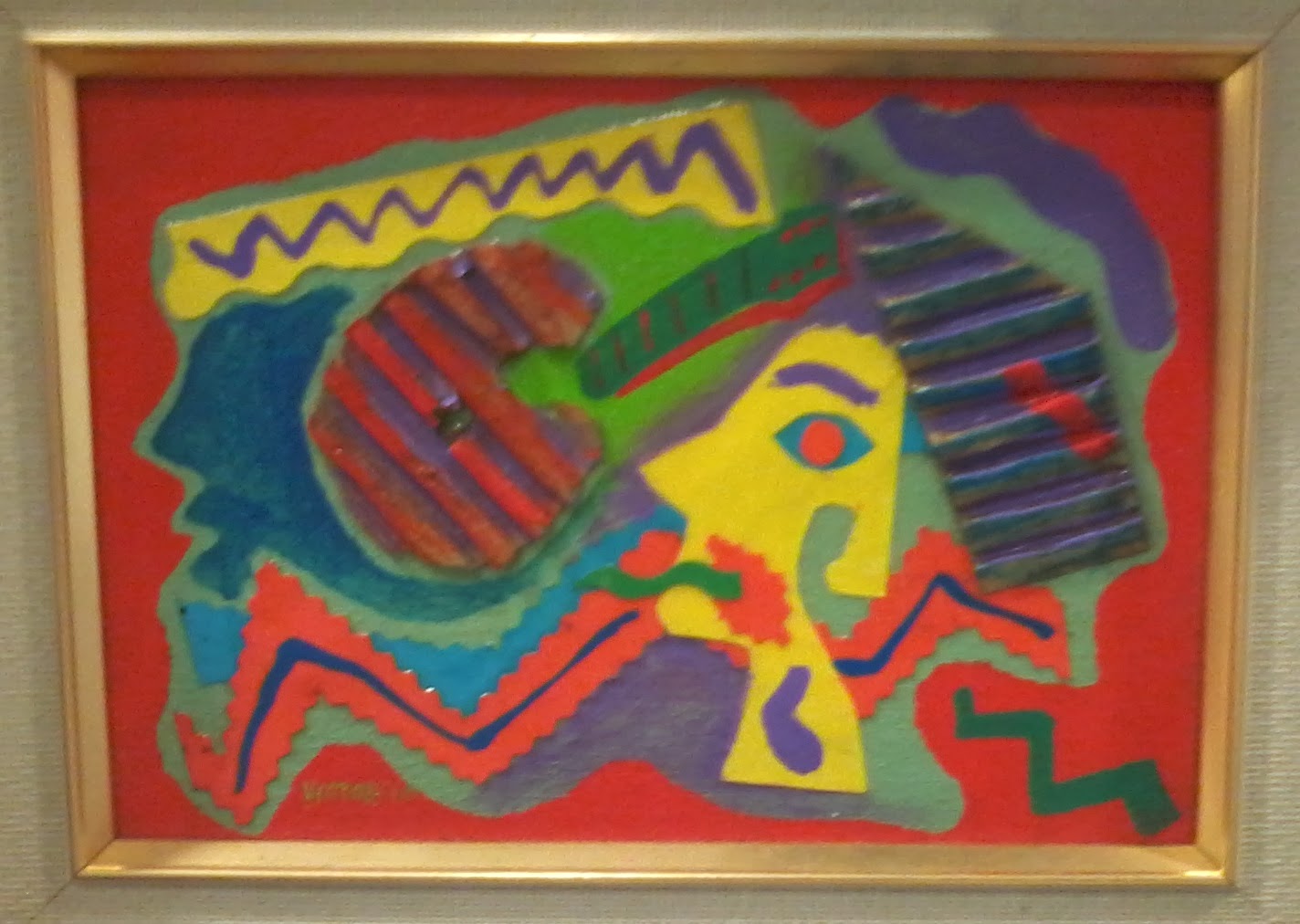
Qric Batilaran
Angel
Oil on canvas
60 x 45.5 cm
2013

 24
Victor Dumaguing
Guitar 3
Mixed media on wood
13.5 x 19 cm
2013


 25
Victor Dumaguing
Guitar 4
Mixed media on wood
13.5 x 19 cm
2013


 26
Johnmark S. Principe
Ang Guitara
Mixed media assemblage
61 x 46 cm
2013 


 27
Kim Vale
Mga Alaala
Mixed media assemblage
65 x 46.5 cm
2013 


 28
Elvin Payong
Old Habits
Mixed media assemblage
64 x 48.5 cm
2013


 29
Cassandra Alanis Cano
Flicker
Acrylic on canvas
61 x 61 cm
2013 


 30
Victor Dumaguing
A Piece of Peace
Mixed media on wood
61 x 61 cm
2013 


 31
Camille Imbo
The Voice
Mixed media assemblage
61 x 46 cm
2013


 32
Dennis Puzon
Old the Time
Mixed media assemblage
70 x 54 cm
2013


 33
Dino Jason Caballes
Light
Mixed media on canvas
61 x 61 cm
2013


 34
Dino Jason Caballes
Melt
Mixed media on canvas
61 x 61 cm
2013 


 35
Ellenita Dumlao
Peace Agenda 2
Acrylic on printed fabric
61 x 61 cm
2013 


 36
Jon Raya
Untitled
Oil on canvas
61 x 61 cm
2013 


 37
Jon Raya
Untitled
Oil on canvas
61 x 61 cm
2013


 38
Randy Mindo
Hinanok
Acrylic on canvas
30.5 x 30.5 cm
2013 


 39
Stella Estremera
Courtship Dance 1
Acrylic on canvas
61 x 61 cm
2013


 40
Stella Estremera
Courtship Dance 2
Acrylic on canvas
61 x 61 cm
2013


 41
Kublai Millan
Untitled 1
Acrylic on canvas
61 x 61 cm
2012 


 42
Kublai Millan
Untitled 2
Acrylic on canvas
61 x 61 cm
2012


 43
Kublai Millan
Untitled 3
Acrylic on canvas
61 x 61 cm
2012


 44
Kublai Millan
Untitled 4
Acrylic on canvas
61 x 61 cm
2012


 45
Kublai Millan
Untitled 5
Acrylic on canvas
61 x 61 cm
2012 

 46
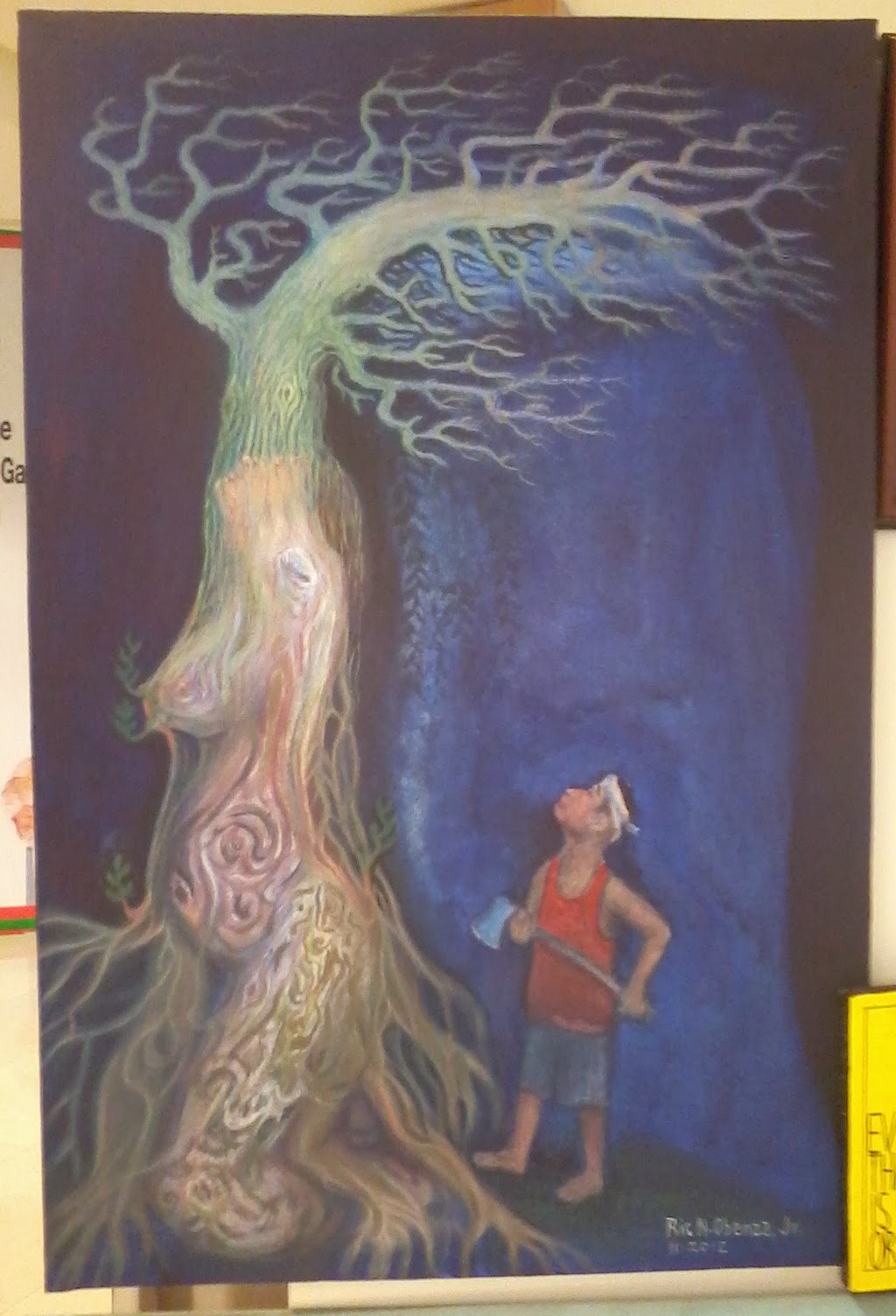
Ricardo N. Obenza
Hiyaw ng Kalikasan
Acrylic on canvas
91.4 x 70 cm
2013


 47
Domingo Arat
Eagle
Acrylic on canvas
91.4 x 90.1 cm
2013


 48
Winny Abonales
Gaugamela
Oil on canvas
24.5 x 34 cm
2003


 49
Winny Abonales
Bamboo
Oil on canvas
56 x 31 cm
2009


 50
Ralph Doron
Sticky Note (2 of 4)
Acrylic on panel
23 x 23 cm
2013


 51
Ralph Doron
Sticky Note (1 of 4)
Acrylic on panel
23 x 23 cm
2013 


52
Ralph Doron
Sticky Note (3 of 4)
Acrylic on panel
23 x 23 cm
2013 

Thursday, December 5, 2013


"In our lives especially (like Nazareth) we have the subtle power of preventing miracles. We do not believe enough in one another, for a start. Or rather we believe a lot of negative small-minded things; we remember every mistake the others ever made; in knowing one another too well, we may not know one another at all. And then we do not believe enough in Christ's liberating power"

See Mt 13:54-58
~ Gospel 2012 (book)

Tuesday, December 3, 2013

Day-to-Day Cases: CASE#1

Yesterday, our philosophy teacher, sir Ryan gave us a group activity. i was the 4th member of our group. i wasn't quite convinced with how we answered this. So i'll try to clear this now. We had to answer this case:

"A father was summoned by his boss to report to the office today. However, he was told by his wife that their eldest child was sick. Should he report to his boss? What moral obligations does the father hold?"

They weren't the exact words used. But that was the idea of it.

Step 1 [Understanding the case]
The father knew that he needed to go to the office because his boss ordered him to do so. He had not reported to his boss yet when he was told by his wife that their eldest child was sick. He may not have left their home yet, or he may have already been on his way to the office when he was told about his child. 

Their child was described as the eldest. We know then that he had other children, otherwise, the child should have been described as the "only" child. 

The severity of the child's sickness was not mentioned. He may be on the brink of death or not yet. We also are unsure of the father's fate if ever he decides to disobey his boss. Will he be fired or will he be allowed to return work after disregarding his duties?

Step 2 [Analyzing the case]
>> bear with me, i am not so used to doing this

According to Kant, moral obligation is universal and excuses no one. We are required to do the right thing. In every situation, there is a right thing to do and a wrong thing not to do, or there is a right thing to do and another more righteous thing to do. In the given situation, we really do not have a clear background that allows us to judge the weight of the father's responsibility - to his job and to his child. Is his role in his office so important that he should leave his child, or is his child's condition so bad that he should not report to the office? 

Therefore, we make assumptions. [this is based on what usually occurs in everyday situations]
1. the child is not dying. He/she may suffer from fever, nothing so grave.
2. the wife could take care of the child and nurse him/her.
3. there is some serious consequence the father will have to face if ever he chooses to disobey his boss. otherwise, he may just choose to accompany his child, and not to report to work without worrying about an angry boss or an unresolved office duty.
4. Let's assume that the child is a boy. So we could do away with the he/she, him/her, etc.. :)

Thus, posing these assumptions, it is clear for me that the father should report to his boss. Why?
1. He has an obligation to his office and he has an obligation to his child. Presenting to work even if he knows his child is sick does not make him less of a father. If his child is old enough to understand that his father is not there when he was sick and the child feels bad about it, then the father has a fault even before his child became sick. He did not make it clear enough, in the days he was with his child, that he loved him. The child may have doubted his father's love because it was never shown to him or the child never felt it. Otherwise, the child, no matter how young his mind is, would understand faith. And he would have faith in his father, who even though is not physically present, mourns with him in his sickness. If his child is still so young and innocent, then it wouldn't very much matter if his father would not be around just this time. Because based on our assumptions, his wife is capable of taking care of the child.

2. Before entering any job, one is aware of the things/people he needs to sacrifice to do the job. For example, if you are a married man with children and you entered the army, you know that you will be away from your family as long as the war is on. You may have heard that your wife already died or one of your children has cancer, but you cannot leave your job. You should have looked forward to situations like this before you entered the job. If you are, however, a married man with children, and you entered any normal job. One is actually free to excuse himself from duty whenever there is an emergency. In our situation, however, his child's sickness is not severe and it is definitely not an emergency. Thus, the father cannot be excused from going to work. Cases like these have been thought upon by lawmakers and it has been applied now in lots of employment. 

3. Any father, who genuinely loves his child, would definitely feel bad about not being able to be by his child's side in times of his child's sickness. It's not as if leaving his child is a decision that he has not thought over. A father  has sacrifices to make. Sometimes, this includes being away from his family .However, there has to be a balance between work and family bonding. After all, fathers, including mothers, work for their family, so they also have to spend time with their family, especially in bad times.

Step 3 [Conclusion]
If i were the father, i would still report to my boss. i love my child more than my boss, but i have responsibilities at work, and sometimes father and son needs to be apart. i will still be checking up on my wife to know how my son is doing.. Son, you'll always be in my heart.. and keep in mind that you should avoid being sick again!


SO... that's all folks! :D that's my analysis of the case! 
Quite lame, but that's the best i could come up to.
And seriously, i'm serious! Hahahaha! :D

Sunday, November 17, 2013

Relief packing operations at DPWH, Panacan, Davao City

this is my first time EVER to join repacking operations in a larger scale!! And i moved like a soldier (i think so)!! Woohoo! i hadn't warmed up. i hadn't brought any extra shirt, yet i pushed through till i get tired!

i wen inside a very large warehouse where thousands of rice sacks were piled up. it is indeed amazing how different individuals united to donate food, especially rice. Filipinos, generally, could't live without rice. 


i saw piles of boxes of canned goods all neatly arranged. i actually thought that there was nothing left to do. When i entered the warehouse, many goods were already repacked into sando bags. So i thought that there were not much work to do.

But i actually found lots to do and also learned something new!


STATION 1A
Rice is divided into smaller amounts, about five kilos each, and placed into a sando bag.
They are then tied and sent to Station 2.
rice from sacks to be repacked into smaller amounts


STATION 1B
Canned goods, coffee, noodles and others are grouped according to the desired contents. 
They are placed into one sando bag.
The sando bag is then tied and sent to station 2.


STATION 2
The rice sando bag and the goods sando bag are packed together in one sando bag.
They are then sent to Station 3


STATION 3
The packaged items are place in sacks.
The sacks are properly tied and they are sent to the truck.
The truck would deliver to where the barges are, and the barges would deliver the sacks to Leyte 
or to wherever the victims are.

 Done! one package composes of canned goods, noodles, coffee, rice and others

i grabbed the opportunity to interview volunteers in the area. Some went there representing their school, some representing their offices, others representing their country (like the Koreans). Like me, a lot of volunteers came there for the first time. But there were also a number of them who kept coming back there since the start of repacking operations. There were military members, DSWD (Departments of Social Welfare and Development) facilitators, and individuals from the different barangays in Panacan area. i asked one barangay member if she doesn't mind leaving her chores and worries at home to help in the repacking for free, and she answered that she can't help it cause it's what needs to be done.  

i met some students who, in spite of being uncomfortable with the task, moved and cooperated with others to do more. i felt like i actually was in a team building activity. You are surrounded with strangers but you need to deal with them in the most systematic way to achieve a goal as effortlessly as possible. Well, as for me, i didn't grasp the whole concept of repacking immediately. It took me some time. And it wasn't effortless. i felt so tired and sweaty. my hands were hurt and it was really such a hot Sunday. Yet, i wanted to send my love to Filipinos in need. i need to send them hope and concern. Sometimes, you really ought to see things in another perspective. i kept asking, "what can i do to reach out to them? How do i help them? i could never help them financially!" these questions led me to an examination of myself. Why did i come here to repack goods? Was is simply to fulfill the dictate of my conscience? i thought about that, but i knew deep in my heart, and deep in other volunteers' sacrifices that all these are not superficial show offs. If not everyone, a lot were sincere in their desire to help. Although, i admit, that i'm not sure if this is the best way to help the typhoon victims.

Anyhow, i met one energetic, clever, generous and artistic lady - ate Adora! She looks really young, yet she's already in her 30s. She was so trustful to me in sharing a bit of herself. She was a computer science graduate and she had a lot of experience in industrial work. She is good in creating concepts for designs and stuffs like that. She even gave me the names of companies that might probably allow students to conduct plant visits. She guided me during the time we were helping out other volunteers. She also taught me the value of every grain of rice. i actually gave her the title of a "rice advocate" (and yes, it was such a lame title). She told me that every grain should be valued because all these grains were intended to help out the victims and not just to be scattered on the floor. 

Nevertheless, there are several criticisms on repacking:

1. there are lots of sacks of rice and lots of boxes of canned goods, why is there a need to repack? Why don't we give one sack and one box for one family? 
2. Repacking rice is a sensitive task to carry out. Rice would be exposed to the repackers and they might contaminate the rice.
3. Due to repacking, lots and lots of sando bags are needed. When these thousands of sando bags reaches the victims, they would eventually have to throw it away. Thus, repacking may further lead to increase in solid wastes.

But there are also advantages in repacking:

1. Repackers create a sense of unity and humility in doing the task. The activity actually fans the flame of the Filipino spirit.
2. Repacked goods are sent into the site with a touch of love.
3. Upon receiving the packed goods, people would need not carry very heavy loads (like one sack of rice) to deliver it to their homes.


Wednesday, November 13, 2013

Vdtd

Veronika Decides to Die
What a book!
it confused me and amused me
it discusses matters on sanity and insanity, fears and dreams,
but most of all, it dealt with life and death.
Read it with an open mind, but also with cautiousness and consciousness.

Saturday, November 2, 2013

Sa Bahay ng Pilosopo (In the House of the Sage)

Galing sa ikadalawampu't limang kabanata ng Noli Me Tangere

Filipino version (as translated by  Pascual H. Poblete with a few editing by me):

"Sapagkat hindi ko iniuukol ang aking sinusulat sa mga taong nabubuhay ngayon; 
sumusulat ako at nang mabasa ng mga taong ipanganganak pa sa mga panahong sasapit. 
Kung mababasa ng mga tao ngayon ang aking mga sinusulat 
ay kanilang susunuguin ang aking mga aklat, 
na siyang pinagkagugulan ko ng pagal ng buong aking buhay; 
datapuwa't hindi gayon ang gagawin ng mga taong ipanganganak pang makababasa ng aking mga sinusulat ngayon; 
sapagkat ang mga taong ipanganganak pang iyo'y pawang magiging mga pantas at mauunawa nila ang aking mga adhika at kanilang wiwikain: 
HINDI NATULOG NA LAHAT SA GABI NG AMING MGA NUNO! 
Ililigtas ng talinghaga o ng mga kakaibang mga letrang ito ang aking gawa, sa kamangmangan ng mga tao, 
na gaya naman ng pagkaligtas sa maraming mga katotohanan ng talinghaga 
o ng mga kakaibang mga pagsamba 
at ng di sirain ng mapangwasak na mga kamay ng mga sakerdote."

English version (from  Oocities org):

"Because I'm not writing for this generation, but for other ages. 
If this generation could read, it would burn my books, the labor of my whole life. 
But the generation that deciphers these characters will be an intelligent generation, 
it will understand and say, 
'NOT ALL WERE ASLEEP IN THE NIGHT OF OUR ANCESTORS!' 
The mystery of these curious characters will save my work from the ignorance of men, 
just as the mystery of strange rites has saved many truths from the destructive priestly classes."

These words of Pilosopo Tasyo always remind me of the courageous individuals who chose to risk their lives in defiance of evil, inequality and injustice. They manifest a people who chose to ask for more than what a mediocre society gives them. They stood up for their rights! They stood up fighting for the cause of freedom and their principles. Indeed, in the event of oppression, war and tyranny, not everyone was asleep, not everyone gave in to an unjust system. Not everyone gave in to suffering. And Rizal was one of them. Writing the Noli Me Tangere and other Spaniard-criticizing books and articles in exchange for his life was practically stupid, but he chose to hope for a revolution of minds and hearts from the future generation. And he knew that it would be worth it. Finally, in the persona of Elias (also in Noli Me Tangere), Rizal expressed how he finds joy in understanding that even if he might not see the sun shine on his Motherland, he knows that a new day is dawning for the future generation and for all those who sacrificed their lives to give birth to that land of the rising sun.